
Clinical evidence is the baseline. The life a patient regains is the measure.
DermaBind. A placental membrane wound covering.

69.1%
Average wound surface area reduction. Published clinical case series, 2025.

Section 361 HCT/P
FDA Tissue Reference Group confirmed. Both TL and FM configurations.

Journal of Wound Care
Peer-reviewed. Multi-site. Real-world clinical conditions.

Hard-to-heal wounds
Every patient in the study had failed at least four weeks of standard of care before DermaBind was applied.

DermaBind TL
A dehydrated tri-layer placental membrane wound covering, preserved with all native layers intact, including the amnion, spongy layer, and chorion.
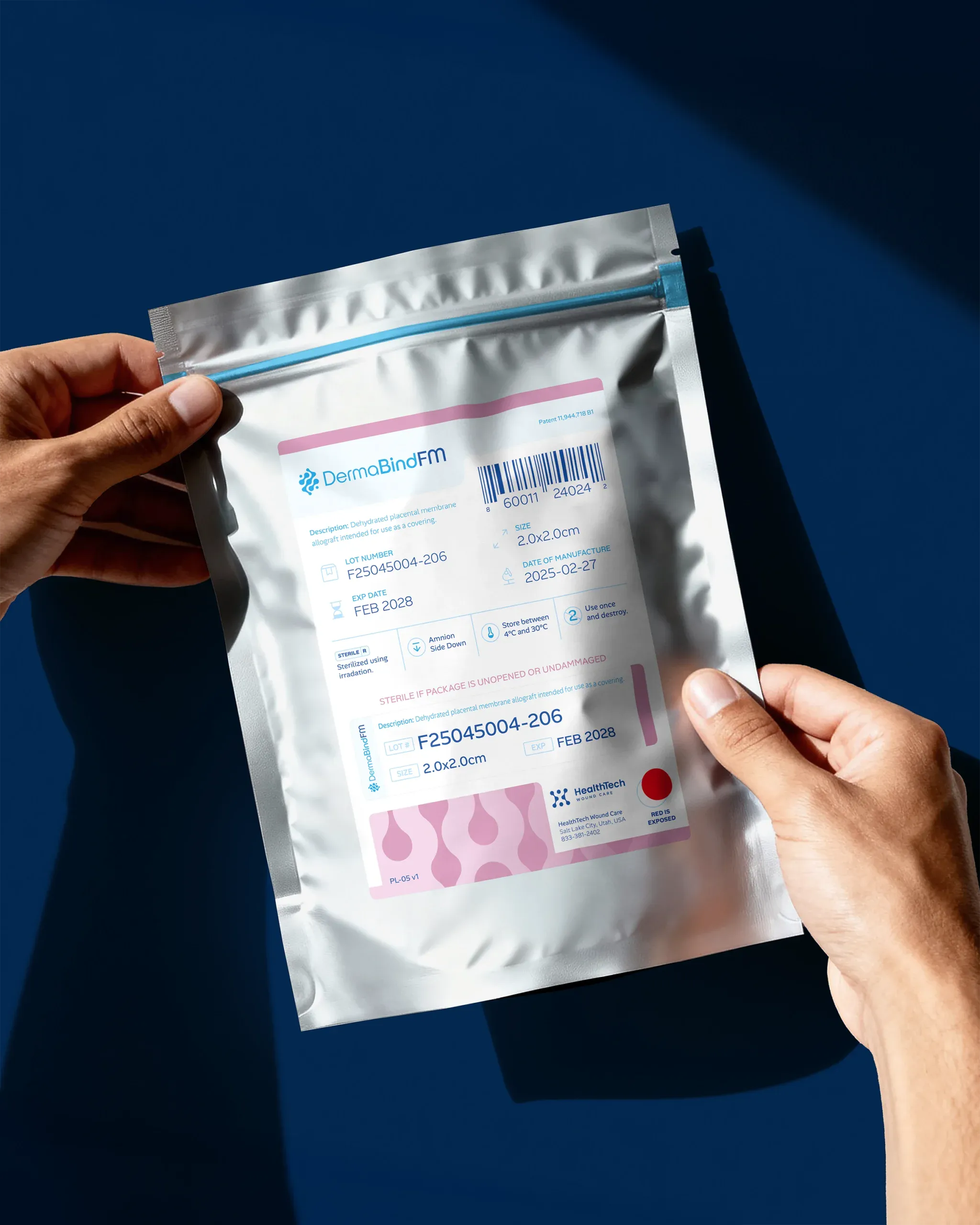
DermaBind FM
A dehydrated full-membrane placental wound covering featuring an orientation notch for precise placement, with all native layers preserved intact.

DermaBind CH
A dehydrated chorion membrane wound covering designed for dental applications, preserving the natural scaffolding proteins of the chorion layer with all native extracellular matrix components intact.
A DEHYDRATED HUMAN PLACENTAL MEMBRANE WOUND COVERING
Every layer of the placenta, preserved exactly as nature formed it.
DermaBind is a dehydrated human placental membrane wound covering whose proprietary preservation method retains all three native layers. We keep amnion, spongy layer, and chorion intact, with over 400 native proteins preserved and nothing added.
Applied to a wound, DermaBind acts as a protective biological covering. It hydrates in situ, requires no preparation at point of care, and stores at room temperature for up to five years. Two configurations are available: DermaBind TL and DermaBind FM, the latter carrying an orientation notch for consistent application.

Section 361 HCT/P
FDA Tissue Reference Group Confirmed – TL and FM
A DEHYDRATED HUMAN PLACENTAL MEMBRANE WOUND COVERING
Every layer of the placenta, preserved exactly as nature formed it.
DermaBind is a dehydrated human placental membrane wound covering whose proprietary preservation method retains all three native layers. We keep amnion, spongy layer, and chorion intact, with over 400 native proteins preserved and nothing added.
Applied to a wound, DermaBind acts as a protective biological covering. It hydrates in situ, requires no preparation at point of care, and stores at room temperature for up to five years. Two configurations are available: DermaBind TL and DermaBind FM, the latter carrying an orientation notch for consistent application.
Section 361 HCT/P
FDA Tissue Reference Group Confirmed – TL and FM

Where would you like to start?

Your protocol, reviewed with you.
Hard-to-heal wounds demand clinical precision at every stage, from patient selection and wound bed preparation through to documentation that withstands scrutiny. If you’re evaluating DermaBind for your practice, we’d rather start with a conversation about your current protocol than a brochure about ours.

A framework for the full arc of care.
The DermaBind Clinical Stewardship Program gives clinicians the tools, education, and clinical guidance they need to care for patients before, during, and after wound treatment. It is built to grow with the industry, with emerging evidence, and with the partners who share its commitment to raising the standard of care. We are building it openly, and we welcome the conversation.

You have questions.
We have time.
Living with a hard-to-heal wound affects everything. If you or someone you care for has been referred for advanced wound care, or if you’re simply trying to understand what comes next, the patient section of this site was written for you.
CLINICAL STEWARDSHIP PROGRAM
The tools to care for your patients with confidence.
The DermaBind Clinical Stewardship Program gives clinicians the documentation frameworks, clinical education, and practice guidance they need to manage wound care patients from first assessment through to resolution. It is built around a simple conviction: that clinical discipline and defensible practice are expressions of the same commitment to patient welfare.
The program is growing. What exists today is the 30-Day Medical Necessity Pathway, a documentation tool designed to make CMS LCD compliance feel like the clinical record it already is. Education, certification, and expanded clinical resources are in development, shaped by the clinicians and partners who use them.

AVAILABLE NOW
The 30-Day Medical Necessity Pathway
A documentation tool designed to make CMS LCD compliance feel like the clinical record it already is. Tracks the 30 days of standard care required for graft eligibility. Five minutes per visit. Documentation-complete on day 30.
CLINICAL STEWARDSHIP PROGRAM
The tools to care for your patients with confidence.
The DermaBind Clinical Stewardship Program gives clinicians the documentation frameworks, clinical education, and practice guidance they need to manage wound care patients from first assessment through to resolution. It is built around a simple conviction: that clinical discipline and defensible practice are expressions of the same commitment to patient welfare.
The program is growing. What exists today is the 30-Day Medical Necessity Pathway, a documentation tool designed to make CMS LCD compliance feel like the clinical record it already is. Education, certification, and expanded clinical resources are in development, shaped by the clinicians and partners who use them.
AVAILABLE NOW
The 30-Day Medical Necessity Pathway
A documentation tool designed to make CMS LCD compliance feel like the clinical record it already is. Tracks the 30 days of standard care required for graft eligibility. Five minutes per visit. Documentation-complete on day 30.

FOR PATIENTS AND FAMILIES
Living with a wound that isn’t healing takes something from you every day.
Whether you are managing a wound yourself or caring for someone who is, the questions can feel overwhelming and the answers are not always easy to find.
The patient section of this site was written to help. It covers what chronic wounds are, what advanced wound care involves, and what you can ask your clinical team at every stage of the process.
FOR PATIENTS AND FAMILIES
Living with a wound that isn’t healing takes something from you every day.
Whether you are managing a wound yourself or caring for someone who is, the questions can feel overwhelming and the answers are not always easy to find.
The patient section of this site was written to help. It covers what chronic wounds are, what advanced wound care involves, and what you can ask your clinical team at every stage of the process.



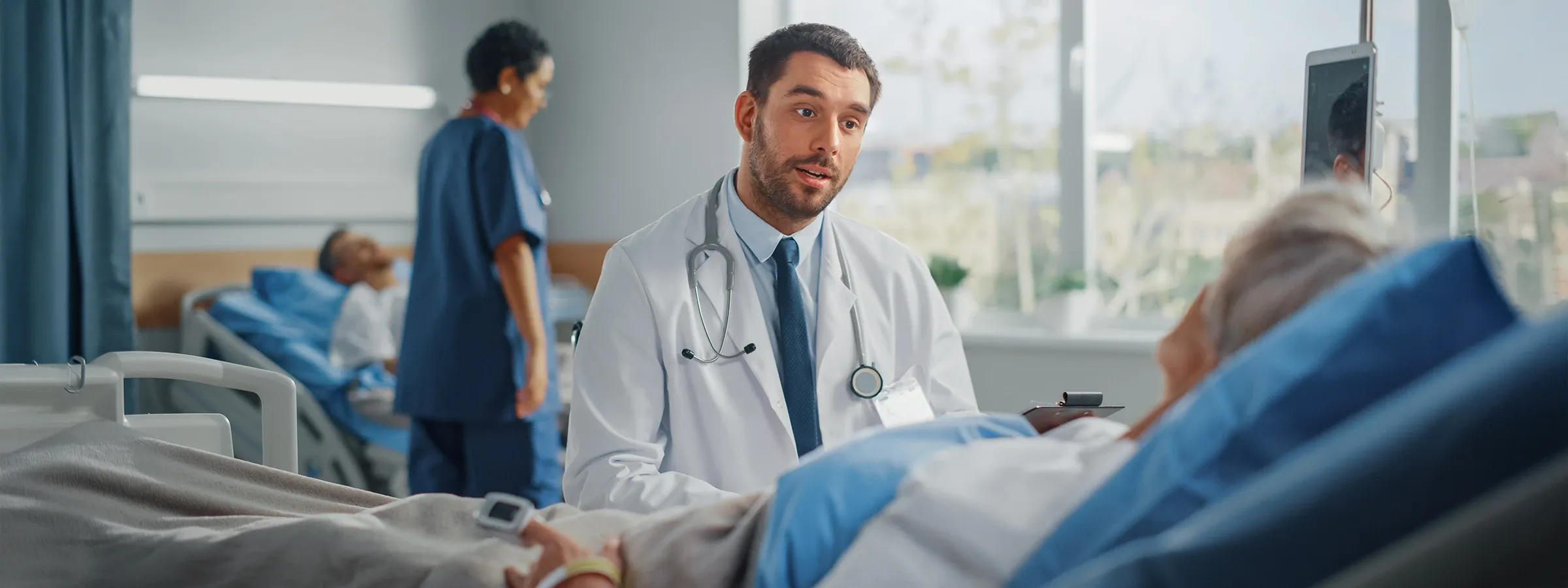
Every conversation about wound care is, at its heart, a conversation about a patient.
Whatever brings you here, we’d like to hear about it.