
The evidence behind DermaBind.
Every claim DermaBind makes is traceable to published, peer-reviewed data or verifiable regulatory documentation. This section sets out the science, the structure, and the regulatory standing of the product.
The evidence behind DermaBind.
Every claim DermaBind makes is traceable to published, peer-reviewed data or verifiable regulatory documentation. This section sets out the science, the structure, and the regulatory standing of the product.
What DermaBind Is
The Evidence
Section 361 – What It Means for Your Practice
Product Specifications
What DermaBind Is
The Evidence
Section 361 – What It Means for Your Practice
Product Specifications

PRODUCT OVERVIEW
A dehydrated human placental membrane wound covering, preserved in full.
A dehydrated human placental membrane wound covering, preserved in full.
DermaBind is processed through a proprietary method that retains all three native layers of the placental membrane: the amnion, the spongy layer, and the chorion, intact and in their original orientation. No chemicals, antibiotics, or preservatives are introduced at any point during processing. The membrane is never frozen.
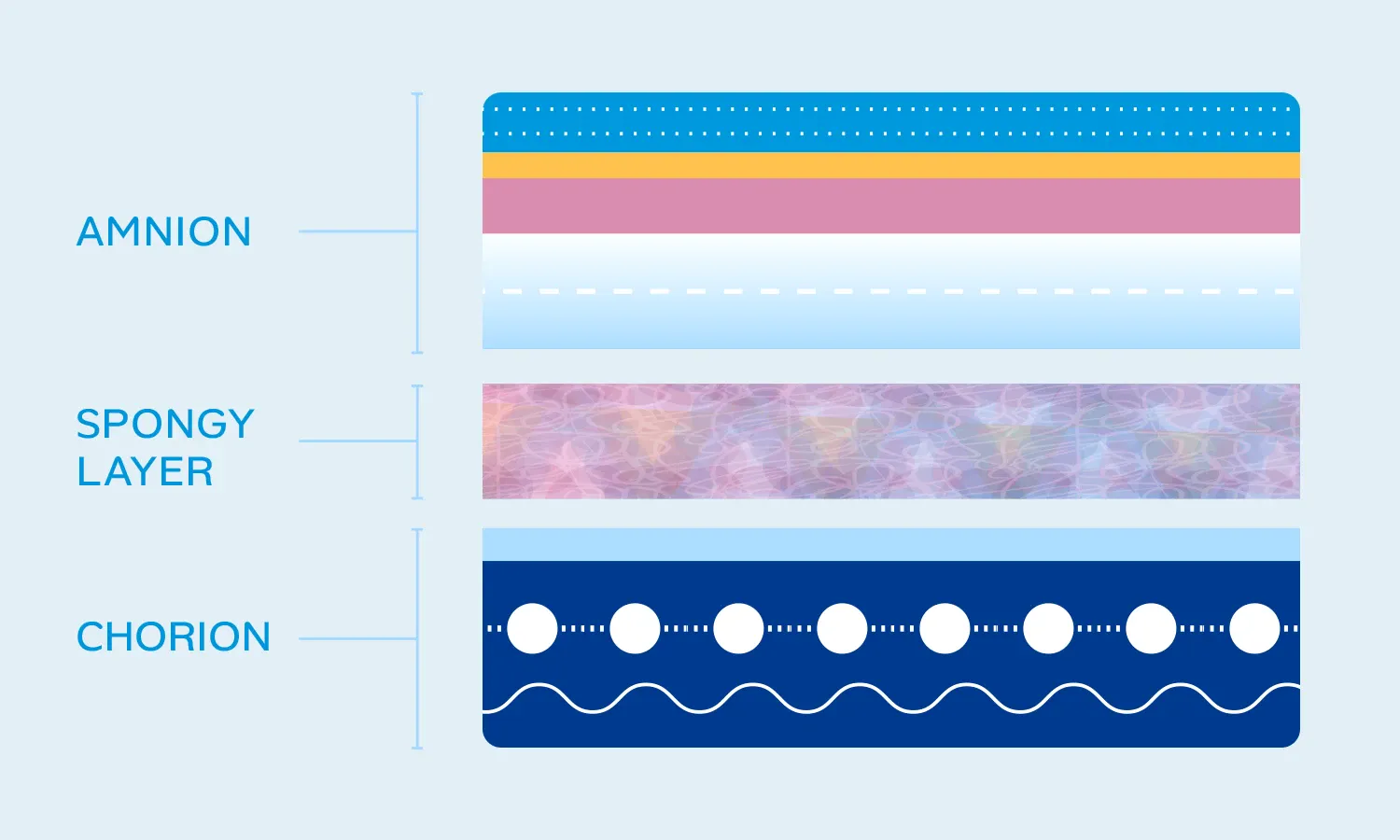
The result is a wound covering whose structural composition reflects the tissue as it existed before processing. DermaBind contains over 400 native proteins including collagens I, III, IV, V, and VI, fibrins, elastins, glycosaminoglycans, glycoconjugates, fibronectin, nidogen, and laminin. The chorion layer provides a semi-permeable biological barrier.

Two configurations
DermaBind TL is the standard configuration. DermaBind FM carries an orientation notch that allows the clinician to identify the amnion side (which is applied directly to the wound bed) without additional preparation steps. Both configurations undergo the same proprietary preservation method and are stored at room temperature for up to five years.

How it is applied
DermaBind hydrates in situ. No pre-hydration or preparation is required at point of care. The graft is applied to a prepared wound bed and secured per clinical protocol. It is suture-ready and durable enough to handle with standard technique.

Section 361 HCT/P
FDA Tissue Reference Group Confirmed – TL and FM

PRODUCT FACT SHEET
Technical specifications for DermaBind TL


PRODUCT FACT SHEET
Technical specifications for DermaBind FM


PEER-REVIEWED CLINICAL DATA
Published in the Journal of Wound Care. November 2025.
Published in the Journal of Wound Care. November 2025.
The clinical case series was published in the Journal of Wound Care North American Supplement, Vol. 34, No. 11, November 2025. It describes the real-world clinical experience of 13 healthcare providers across the United States using DermaBind TL or FM as a wound covering in hard-to-heal wounds of various aetiologies.

Study design
A retrospective, uncontrolled, multi-site case series. Twenty-seven patient cases encompassing 36 wounds were collected between 2023 and 2025. All patients were adults aged 18 or over with wounds that had failed to heal following a minimum of four weeks of standard care. Data were collected and reviewed independently of the treating providers.

Patient population

Key findings
Average wound surface area reduction across all 36 wounds: 69.1% (range: -17.6% to 100%). Nine wounds (25%) achieved complete resolution. 28 wounds (77.8%) achieved 50% or greater surface area reduction. Average duration of treatment: 6.7 weeks.

Limitations

Reporting Standard
These outcomes are reported descriptively, consistent with the study design. They are not intended to imply a direct causal effect of DermaBind on wound healing and do not constitute a therapeutic claim. Confounding factors, including concomitant therapies and variable follow-up intervals, are documented fully in the published paper.
These outcomes are reported descriptively, consistent with the study design. They are not intended to imply a direct causal effect of DermaBind on wound healing and do not constitute a therapeutic claim. Confounding factors, including concomitant therapies and variable follow-up intervals, are documented fully in the published paper.


CLINICAL CASE SERIES
Journal of Wound Care, November 2025.
Full published paper: real-world clinical experience with DermaBind TL and FM in hard-to-heal wounds. Multi-site. 27 patients, 36 wounds. Peer-reviewed.
CLINICAL CASE SERIES
Journal of Wound Care, November 2025.
Full published paper: real-world clinical experience with DermaBind TL and FM in hard-to-heal wounds. Multi-site. 27 patients, 36 wounds. Peer-reviewed.

REGULATORY CLASSIFICATION
Section 361 HCT/P: What it is, and why it matters to your practice.
Section 361 HCT/P: What it is, and why it matters to your practice.
DermaBind TL and DermaBind FM are regulated as Human Cells, Tissues, and Cellular and Tissue-Based Products (HCT/Ps) under Section 361 of the Public Health Service Act and 21 CFR Part 1271. This classification was confirmed by the FDA Tissue Reference Group (TRG) for DermaBind TL on January 5, 2023, and for DermaBind FM on November 3, 2023.
DermaBind TL and DermaBind FM are regulated as Human Cells, Tissues, and Cellular and Tissue-Based Products (HCT/Ps) under Section 361 of the Public Health Service Act and 21 CFR Part 1271. This classification was confirmed by the FDA Tissue Reference Group (TRG) for DermaBind TL on January 5, 2023, and for DermaBind FM on November 3, 2023.
Section 361 classification means the product meets all four criteria set out in 21 CFR § 1271.10(a): it is minimally manipulated, intended for homologous use, not combined with a drug or device, and does not raise systemic safety concerns. Products meeting these criteria are regulated differently from drugs and devices.
Section 361 classification means the product meets all four criteria set out in 21 CFR § 1271.10(a): it is minimally manipulated, intended for homologous use, not combined with a drug or device, and does not raise systemic safety concerns. Products meeting these criteria are regulated differently from drugs and devices.

What this means for prescribing clinicians
Section 361 HCT/Ps are not subject to pre-market approval or clearance requirements that apply to drugs and biologics. The product does not carry claims of therapeutic benefit. Clinicians apply DermaBind as a wound covering based on their clinical judgment and documented medical necessity, consistent with CMS LCD requirements.

What this means for reimbursement
DermaBind is reimbursed under CMS Local Coverage Determinations governing skin substitute grafts and cellular and tissue-based products. Eligibility requires documented failure of standard care over a minimum of 30 days prior to application, among other criteria. The Section 361 classification is verifiable and supports audit defensibility.

30-Day
Medical Necessity Pathway
A documentation tool designed to make CMS LCD compliance feel like the clinical record it already is.
A documentation tool designed to make CMS LCD compliance feel like the clinical record it already is.
DermaBind TL & DermaBind FM Specifications
Dehydrated placental membrane covering. Preserves comprehensive collagen matrix, glycoconjugates, and glycosaminoglycans.
LAYERS
Amnion / Spongy layer / Chorion — all three retained intact.
COMPOSITION
400+ proteins including collagens I, III, IV, V, VI; fibrins; elastins; glycosaminoglycans; glycoconjugates; fibronectin; nidogen; laminin.
PROCESSING
Proprietary preservation method. No chemicals, antibiotics, or preservatives. Never frozen.
STERILIZATION
Gamma irradiation, 17.5 kGy (SAL 10-6).
STORAGE
Ambient temperature (4°C to 30°C). Up to five years.
PREPARATION AT POINT OF CARE
None required. Hydrates in situ.
ORIENTATION
Orientation label on packaging indicates amnion side down.
APPLICATION
Suture-ready. Suitable for partial- and full-thickness acute and hard-to-heal wounds.
MANUFACTURING
HealthTech Wound Care, Inc. ISO-certified facility, Salt Lake City, Utah.
DONOR SCREENING
Full-term live births (34+ weeks gestation). 150-question lifestyle and medical history evaluation plus full laboratory testing.
Dehydrated placental membrane covering. Preserves comprehensive collagen matrix, glycoconjugates, and glycosaminoglycans.
LAYERS
Amnion / Spongy layer / Chorion — all three retained intact.
COMPOSITION
400+ proteins including collagens I, III, IV, V, VI; fibrins; elastins; glycosaminoglycans; glycoconjugates; fibronectin; nidogen; laminin.
PROCESSING
Proprietary preservation method. No chemicals, antibiotics, or preservatives. Never frozen.
STERILIZATION
Gamma irradiation, 17.5 kGy (SAL 10-6).
STORAGE
Ambient temperature (4°C to 30°C). Up to five years.
PREPARATION AT POINT OF CARE
None required. Hydrates in situ.
ORIENTATION
Notch on graft identifies amnion side for consistent application without reference to packaging.
APPLICATION
Suture-ready. Suitable for partial- and full-thickness acute and hard-to-heal wounds.
MANUFACTURING
HealthTech Wound Care, Inc. ISO-certified facility, Salt Lake City, Utah.
DONOR SCREENING
Full-term live births (34+ weeks gestation). 150-question lifestyle and medical history evaluation plus full laboratory testing.

Let’s look at your protocol together.
Tell us about your practice and the patients you’re managing. We’ll come back to you with something useful.
Tell us about your practice and the patients you’re managing. We’ll come back to you with something useful.